

The chart that explains this fall
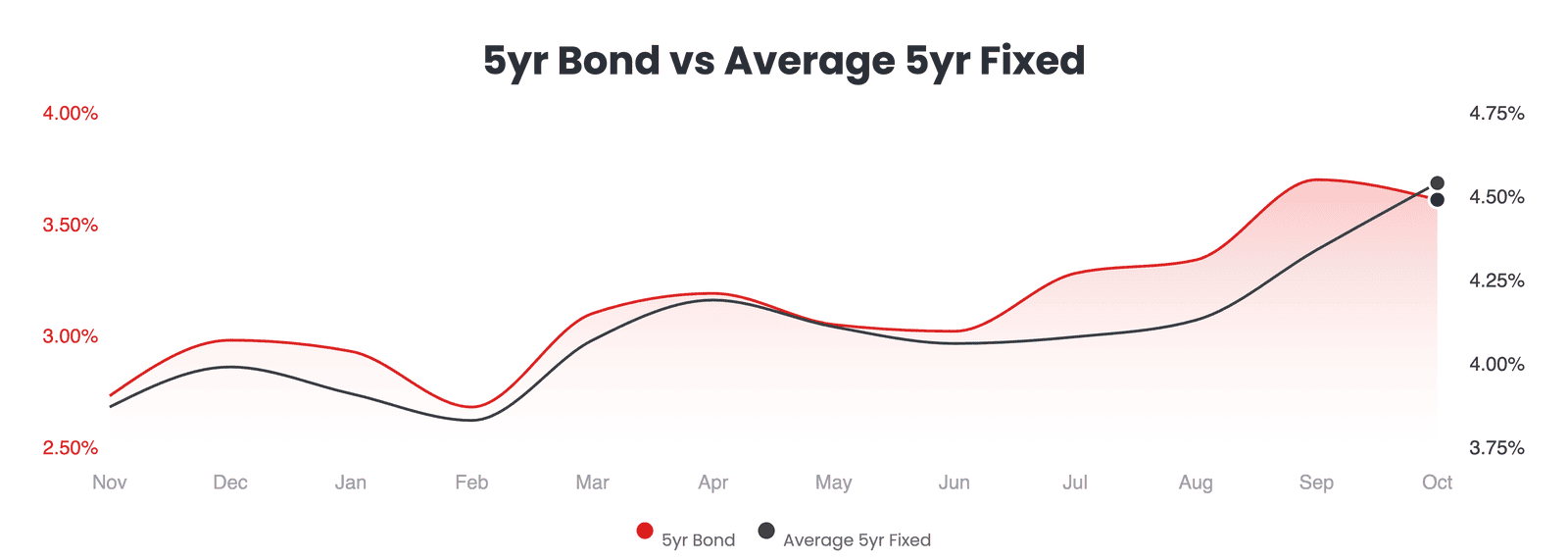
Source: Mortgage Logic News
If you only follow the Bank of Canada, you’d think nothing has happened to mortgage rates in a year. The Bank has held its rate at 2.25% at every announcement since last October, so prime is still 4.45% and variable-rate payments haven’t changed.
Fixed rates tell a different story. The chart above tracks the market average, and it has climbed steadily since early summer as the 5-year bond yield rose. At the lender level, the move has been even bigger. In August, the best 5-year fixed rates were just under 4%. Today, the major lenders I work with are sitting at roughly 4.85% to 5%. That’s close to a full percentage point in about two months.
There was no announcement and no headline. The rate sheets just moved.
Where rates look to be heading
I don’t make rate predictions, and anyone who tells you exactly where rates will be next spring is guessing. What I can tell you is which way the pressure is pointing right now.
- Markets now expect the Bank to move. After the Governor’s comments last weekend, markets see a quarter-point hike on October 28 as more likely than not, with more priced in by December. A year ago the conversation was about how many cuts were left. That conversation is over for now.
- The October dip is already gone. Bond yields eased for the first couple of weeks of October, and it looked like fixed rates might get some relief. Most of that drop has now been wound back up. The 5-year yield jumped back to where it started the month in a single day this week.
- Lenders are still catching up. Fixed rates kept rising even while bonds dipped, because lenders reprice with a lag. With yields back up, there’s little room for fixed rates to come down in the near term.
- Variable isn’t standing completely still either. Prime hasn’t moved, but some lenders are quietly offering smaller discounts off prime on new variable mortgages. And if the Bank does raise rates on October 28, prime and every variable rate tied to it move up the same day.
The next two Bank of Canada announcements are October 28 and December 9.
Why fixed moved when the Bank didn’t
Quick version, since I covered this in September: lenders price 5-year fixed mortgages off 5-year Government of Canada bond yields, plus a margin. When those yields rise, fixed rates follow, whether or not the Bank of Canada does anything. Variable rates follow prime, and prime follows the Bank. That’s why the two have moved in completely different directions since August.
What the move costs
A point sounds abstract. Here’s what it looks like on a real payment. On a $600,000 mortgage with a 25-year amortization:
- At 3.89%, the monthly payment is about $3,120.
- At 4.84%, it’s about $3,435.
That’s roughly $315 more every month, or close to $18,900 over a 5-year term, for the same house and the same mortgage. The only difference is when the rate was locked.
Why a rate hold matters right now
A rate hold (a pre-approval with a guaranteed rate) locks today’s rate for a set period, usually up to 120 days depending on the lender. If rates go up while you’re shopping, you keep the lower rate. If rates come down before you close, you can usually take the lower one. You don’t give anything up by having one in place.
If you’re buying in the next few months, get a rate hold now, before you start writing offers. If you already have a pre-approval, check when the rate on it expires. Many expire quietly, and you’ll find out the day you need them.
If your mortgage renews in the next six months, don’t wait for the renewal letter. Your current lender will usually want you to sign your renewal right away. If you switch lenders, the new lender can guarantee you a rate for up to four months ahead of your renewal date. You hold that rate, watch the market, and if rates come down before your renewal, we update it to the lower one. Starting four to six months out gives you that protection and options. Starting three weeks out usually means signing whatever arrives in the mail.
If you’re in a variable rate today, nothing here means you need to panic. But with a hike now on the table for October 28, it’s worth knowing what a fixed rate would cost you today, and what an extra quarter point does to your payment, so neither one is a surprise.
Fixed or variable, honestly
There’s no single right answer, and I won’t pretend there is.
- Fixed gives you a payment that can’t change for the term, and with hikes being priced in, that certainty matters. But with a fixed rate, you’re often paying the premium for that protection up front. You’re paying today for rate increases on variable that may or may not happen. Breaking a fixed mortgage can also carry a large penalty.
- Variable is still priced off a prime rate that hasn’t moved in a year, and breaking it usually costs three months’ interest. The trade-off: if the Bank of Canada raises rates, your payment or interest cost goes up with it.
The real question is the spread. Right now a typical 5-year variable is around 1.1 points below a 5-year fixed. For the variable to cost you more over the term, prime would need to climb roughly four or more quarter-point hikes and stay there for a good part of your term. So compare what you’re getting on the fixed, how big the spread is to the variable, how likely it is that the variable reaches or passes that fixed rate, and which one leaves you with the better net rate over the term. Your budget and how much payment movement you can live with matter just as much.
This week’s rate update
Every week I post a short video breaking down what moved rates and what it means for you. I’ve also launched a new Instagram account, so if you’d like these updates in your feed, follow along at @tully.mortgages.
Watch this week’s 1-minute rate update →
The takeaway
Your rate is decided by the market you close or renew in, not the one you shopped in. Fixed rates have already moved close to a full point, the October dip has been erased, and markets now expect the Bank of Canada to raise rates. If you have a purchase or a renewal coming in the next six months, the best time to lock in protection is before you need it.
If you’d like me to put a rate hold in place or look at your renewal options early, I’m happy to walk you through it.
Overview
Subscribe to begin.
Join 7.5k+ subscribers and get tips, strategies and market updates every other Thursday morning.