
The morning after the Bank of Canada’s announcement, two clients emailed me with almost the same question: “Did my mortgage just go up?”
One has a fixed rate with three years left. The other has a variable. One answer was “no,” and the other was “yes, a little.” That’s the thing about a rate hike: the headline is the same for everyone, but what it means depends entirely on the mortgage you have. So here’s what happened, what it means for your situation, where rates look to be heading, and what I’d actually do about it.
What happened
On October 28, the Bank of Canada raised its policy rate by a quarter point, from 2.25% to 2.5%. It’s the first increase since July 2023. Prime rose the same day, from 4.45% to 4.70%.
The reason is inflation, driven mostly by oil prices and the conflict in the Middle East. The Bank now expects inflation to reach about 3½% by the end of this year, average around 3% through 2027, and not get back to its 2% target until mid-2028.
If you’ve been watching fixed rates, none of this is a surprise. They had already climbed close to a full point since August, because bond markets saw this coming well before the Bank acted. I covered why fixed rates move before the Bank does two weeks ago.
What it means for you
Line of credit or HELOC: your rate went up the same day. Expect about $21 more per month for every $100,000 you owe.
Variable rate, adjustable payment: your payment goes up with prime. On a 25-year amortization, that’s about $14 more per month per $100,000.
Variable rate, fixed payment: your payment stays the same, but more of it now goes to interest and less to your balance. If rates keep rising, you can eventually hit what’s called your trigger rate, where your payment no longer covers the full interest. Lenders usually reach out as you get close, but it’s worth knowing your number now.
Fixed rate: nothing changes until your renewal.
Renewing in the next 12 months: your new rate will be set by the market at the time you renew, not by this week’s headline. The good news: you have more control over that timing than most people think (more below).
Pre-approved with a rate hold: you’re protected. Check your expiry date, because a hold has to cover your closing date, not just your offer date.
Where rates look to be heading
I don’t predict rates, but I can show you what the market is pricing.
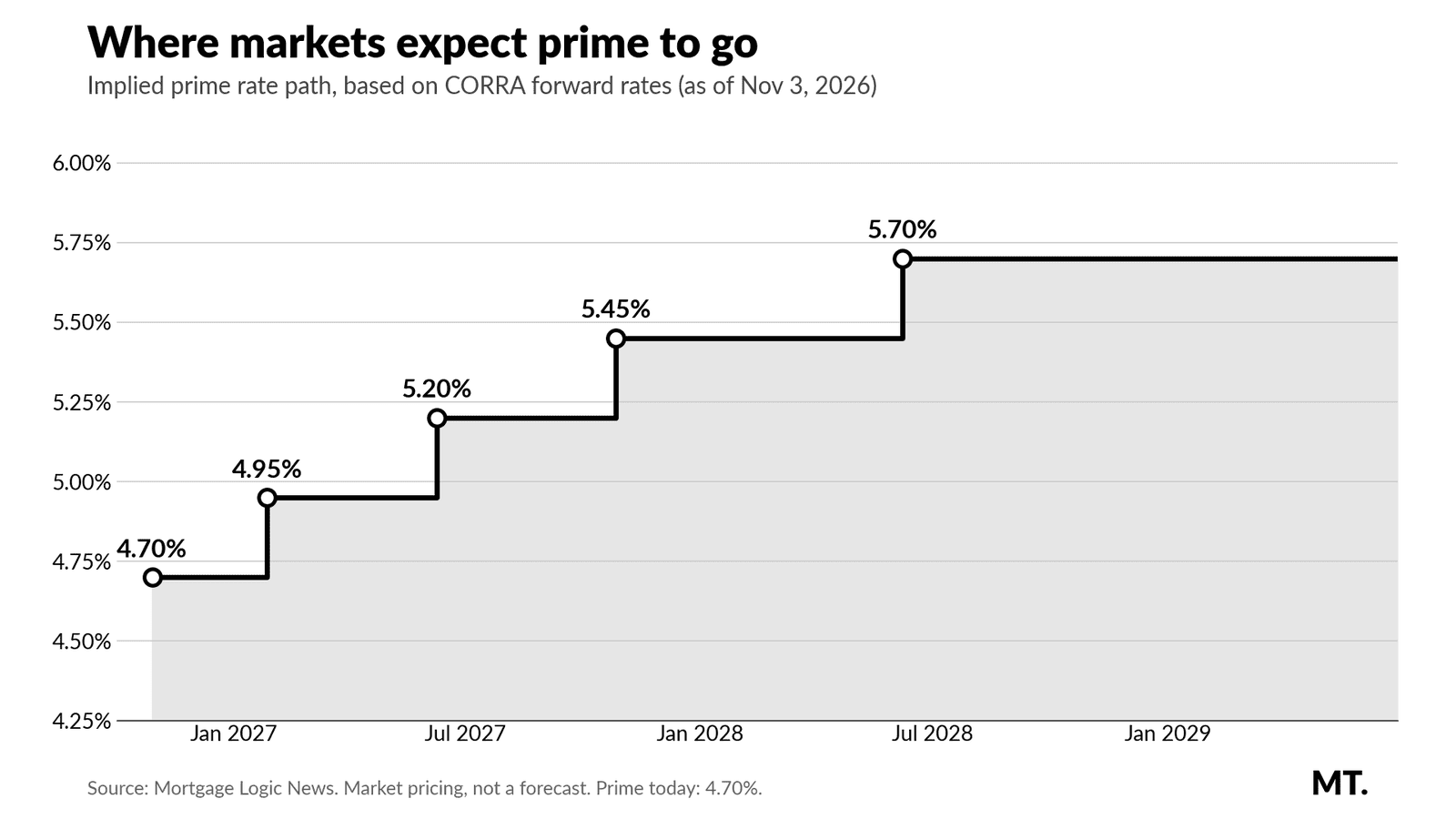
Source: Mortgage Logic News
Based on CORRA forward rates, markets expect prime to go from 4.70% today to about 4.95% by January, then step up to about 5.45% by late 2027 and 5.70% by mid-2028. That’s roughly four more quarter-point increases, about a full point on every variable rate and line of credit. On $100,000, that’s about $83 more a month on a line of credit and about $56 more on a variable mortgage.
A few honest caveats:
- This is pricing, not a promise. A year ago, markets were pricing more cuts. Things change quickly.
- The Bank is in no rush. In its own words, there “could be a need to increase the policy rate further, but given uncertainties, Governing Council agreed to proceed carefully.” Before the announcement, markets saw a December hike as close to certain. Now it’s roughly a coin flip.
- Risks go both ways. Higher oil and stubborn inflation push rates up. A ceasefire or a slowing economy could pull them down.
The next decision is December 9.
What to do with your mortgage
If you’re variable: don’t panic-lock. Today’s best 5-year variable rates are roughly a point below 5-year fixed. If prime rises the full point markets expect, variable ends up close to today’s fixed rate by mid-2028. Since it takes well over a year to get there, variable could still come out ahead over five years. The flip side is real: hikes may not stop where they’re priced, and you’d feel each one right away. If the payment movement is keeping you up at night, raising your payment now or locking part of it into a fixed rate are both options.
If you’re carrying a line of credit balance: this is the most exposed debt you have. Moving part of it into a fixed term can take the guesswork out.
If you’re buying in the next few months: get a rate hold before you start writing offers.
If you’re fixed and not renewing soon: sit tight. Nothing to do yet.
If you’re renewing in the next 12 months: this is where it gets interesting.
Renewing early: when the penalty pays for itself
If rates are heading up, locking in early can make sense. Start with the options that don’t cost anything:
- Switch-lender rate hold. If your renewal is within about four months, a new lender can hold today’s rate for you. If rates drop before your renewal date, we update to the lower rate.
- Your lender’s early-renewal window. Many lenders let you renew early without a penalty, typically within a few months of your maturity date.
If you’re further out, say six to eight months, renewing early usually means breaking your mortgage. That costs you twice: the penalty (usually three months’ interest near the end of a fixed term), and the months you give up at your current low rate.
Here’s an example. You have a $500,000 mortgage at 2.49%, locked in late 2021, with seven months left. You renew early today at 4.94%:
- Penalty: about $3,100
- Giving up 2.49% seven months early: about $7,000 in extra interest
- Total cost: about $10,100
Is that worth it? It depends on where fixed rates are when you would otherwise renew. If they’re about half a point higher seven months from now, you break even. If they’re a full point higher, renewing early saves you roughly $10,000 in interest over the next five years. If rates stay flat or fall, you’ve paid $10,000 for nothing.
One thing to keep in mind: today’s fixed rates already reflect most of the hikes markets expect. So renewing early only pays off if fixed rates rise more than what’s already priced in. That’s possible, but it’s a bet, not a sure thing.
There’s also a middle option: a blend-and-extend with your current lender. You stay put, extend your term, and get a rate that blends your old rate with today’s. It often avoids most of the penalty.
The bottom line: this is worth running for your own mortgage, not a blanket yes or no.
This week’s rate update
Oil dropped 7% on Iran peace-talk hopes, and Canadian factories just shrank for the first time this year. That gives lenders room to bring fixed rates down. But oil was already bouncing back the next morning, and markets still expect the Bank of Canada to hike again.
Watch this week’s rate update →
The takeaway
This rate hike changed some mortgages and not others. If you’re fixed, nothing has changed yet. If you’re variable or carrying a line of credit, you’re already paying a little more, and markets expect more increases. If you’re renewing in the next year, the decision you make in the next few months could be worth thousands.
If you’d like me to run the numbers on your own mortgage, whether that’s fixed vs variable, an early renewal or a blend-and-extend, I’m happy to walk you through it.
Overview
Subscribe to begin.
Join 7.5k+ subscribers and get tips, strategies and market updates every other Thursday morning.